
UFL Stadiums
Fluctuating stadium occupancy for the United Football League has put more public scrutiny on the league’s venue selection for teams.
As a media product, football games with higher occupancy and “fuller” stands are far more appealing to viewers on television. Modern versions of American football are deeply focused on media distribution as the bottom line for revenue growth and expansion.
So, here is a record of the current stadium homes and stadium changes for the UFL.
| Team | Stadium |
|---|---|
| Columbus Aviators | Historic Crew Stadium (2026-2026) |
| Dallas Renegades | Choctaw Stadium (2020-2023) Toyota Stadium (2026-2026) |
| DC Defenders | Audi Field (2020-2026) |
| Louisville Kings | Lynn Family Stadium (2026-2026) |
| Orlando Storm | Inter.co Stadium (2026-2026) |
| St. Louis Battle Hawks | Dome At America’s Center (2020-2026) |
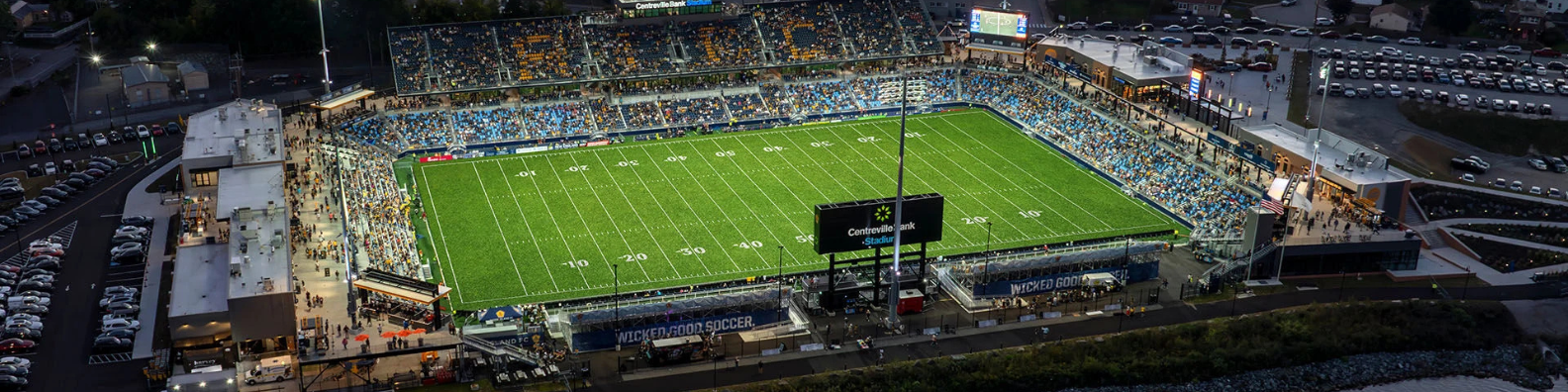
| Rhode Island Breakers | Centreville Bank Stadium (2027) |
| Houston Gamblers | Astro Dome (1984-1985) Protective Stadium/Legiant Field (2022) Simmons Bank Liberty Stadium (2023) Rice Stadium (2024) TDECU Stadium (2025) Shell Energy Stadium (2026) |
| Birmingham Stallions | Legion Field (2022) Protective Stadium (2022-2026) |
Why does the UFL play in smaller venues?
The United Football League focuses on smaller venues because the ownership group/Mike Reople desire fuller-looking stands, lower operating costs, and a “more livey” atmosphere for viewers.
When Reople took over the league’s business operations, he claimed “venue and attendance” were top priorities for changing league perception.
Perception is reality. Before the shift, the reality for markets outside St. Louis consisted of poor attendance and sparse crowds of roughly 5,000 to 12,000 folks. Repole said he would take the blame if he could not lift each team to 10,000-15,000.
Mike Reople has openly discussed the focus of the UFL as a developmental league to evolve players into their next steps within the broader American football landscape. The public stance of “developmental league” can justify staunch policies around paying players and coaches fairly for the considerably risks and sacrifices they take.
“If they have the drive and the passion and they want to make the NFL, and that’s their dream, then we want to help them,” Repole said. “But if they’re looking for, ‘Hey, where’s my next check, or am I going to play next year?’ then this is probably not the league for you. And if you’re in this league four or five years, you probably shouldn’t be here. You should probably go into coaching or do something else.”
– “UFL changes 3 cities as new investor shares bullish vision for spring football” by Schuyler Dixon, Associated Press
What changed
For 2026, the Columbus Aviators, Orlando Storm, and Louisville Kings began play in soccer venues, while the Dallas Renegades and Houston Gamblers moved into MLS stadiums (Front Office Sports).
The league also dropped Detroit even though its attendance was rising, because Ford Field was no longer an option and the city has no soccer stadium. Repole said it came down to “the market and the stadium” (Front Office Sports).
The expansion follows the same model. The Rhode Island Breakers open in Pawtucket’s Centreville Bank Stadium in 2027 under a three-year stadium contract (Boston Globe). Colorado Springs joins in 2027, with Utah and Oklahoma City following in 2028 (Field Level Media).
Did this UFL stadiums strategy work?
League-wide regular-season attendance fell 20% in 2026 to an average of 10,501, even with the new markets in place (Awful Announcing).
The Birmingham Stallions dropped 16% (ESPN), the St. Louis Battlehawks fell 21% to 23,257, and the DC Defenders fell 31% to about 9,000. Repole apologized to both cities and said resources had gone to the new markets (ProFootballTalk).
TV was steadier. Fox games averaged 670,000 viewers, up 4% from 2025, though Nielsen’s new measurement method generally lifts live sports numbers, so year-over-year comparisons need caution (Awful Announcing).
Houston shows that venue size is not the whole story. The Gamblers moved to a smaller MLS stadium in 2026, and in July the league announced it was leaving both Houston and Birmingham (Click2Houston). Repole had also criticized Birmingham’s Protective Stadium as too large for the league’s strategy (ABC 33/40).
The tradeoff: shared buildings
Most of these venues have other tenants. In 2026, the Orlando Storm earned a home playoff semifinal, but Inter&Co Stadium was already booked and the league could not find a nearby alternative. The game moved to a neutral site nearly 1,000 miles away in Columbus (ESPN).